
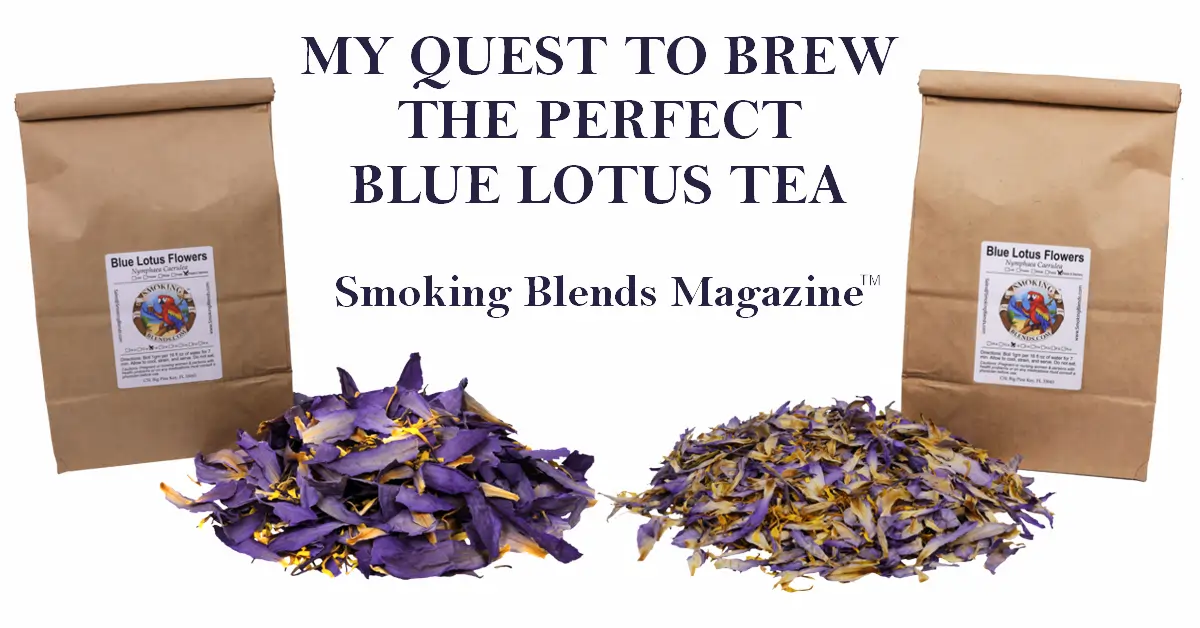
Fresh and fresh-dried blue lotus flowers are highly aromatic and have a strong, inviting fragrance that can vary from a sweet candy to blueberry- or grape-like. The first time I smelled blue lotus, I thought, “These flowers would make an absolutely delicious tea.” And they do. Blue lotus tea is a mild, floral, sometimes slightly bitter tea, depending on the quality and variety of flower. However, I could not help but feel like something was missing.
- Should the whole flower be used or just the petals and stamens?
- Should they be boiled or simmered, and for how long?
- What is the best medium? Water, milk, wine, or something else?
- What variation of blue lotus makes the best tea?
I set out to find the answers to these questions and others.
What is Blue Lotus?
Note: This section includes direct historical accounts of how blue lotus was used medicinally in ancient Egypt and India. At this time, there are no human studies on its potential medical benefits. Any historical claims remain unproven and are not to be considered medical advice.
Blue lotus is actually a water lily with leaves that float on top of the water (lily pads), as opposed to an actual water lotus with leaves that are held above the water. This common name is most often applied to two variations of the plant, Nymphaea nouchali (native to southern and eastern parts of Asia) and Nymphaea nouchali var. caerulea (native to Africa and Egypt). Both flowers are known to contain the same potentially beneficial compounds. Although some have claimed the caerulea variation contains slightly higher amounts, there is no actual proof of that, and it is unlikely to be the case.
Nymphaea nouchali was being actively used in Indian Ayurvedic medicine at the same time caerulea was being used by the Egyptians in traditional wellness practices and religious ceremonies. Both regions were active trading partners, proven by the Egyptians finding great value in the sacred lotus (Nelumbo nucifera) known to the Egyptians as “Red Lotus” that they acquired from India. If Ayurvedic practitioners felt the caerulea variation was superior to Nymphaea nouchali, they would have acquired it in trade.
The Egyptian use of blue lotus (Nymphaea nouchali var. caerulea) dates back nearly 5,000 years to the Early Dynastic Period (circa 3000 BCE). However, the flower’s impact on Egyptian society peaked during the New Kingdom, roughly 3,000 to 3,500 years ago (1500 to 1000 BCE). During this time, blue lotus (Nymphaea nouchali) was also an active part of Indian culture. As Egyptians were carving images of the flower onto temple walls along the banks of the Nile River, sages in the Indus Valley were documenting its traditional uses in what was the beginning of documented Ayurvedic medicine.
Blue Lotus: History of Medicinal Use
Documented in medical texts like the Ebers Papyrus, the ancient Egyptians used blue lotus to help with a variety of ailments, which they thought were both physical and spiritual. It was believed that blue lotus could help with anxiety, muscle cramps, and was an aphrodisiac that could help with sexual dysfunction. This natural remedy was prepared by infusing the flowers into wine or beer.
In India, early Ayurvedic doctors fully separated the flower’s physical properties from spiritual beliefs. The flowers were believed to help lower fevers and calm agitation. In Ayurvedic medicine, blue lotus is referred to as Medhya, which means “good for the mind,” and Hridya, which means “comforting for the heart”. Ayurvedic practitioners made a concoction from the flowers by simmering them in cow or goat’s milk.
The Spiritual Impact of Blue Lotus
To the ancient Egyptians, the way the blue lotus flower opens at dawn and closes at dusk represented the sun and creation and was a direct sign from the Sun God Ra. During funerals fresh and dried blue lotus flowers were sewn into burial garlands and draped over the body to ensure the deceased would rise again in the afterlife. Blue lotus petals were infused into wine so priests and royalty could commune directly with the divine.
In ancient India, the blue lotus flower was seen as an offering that represented spiritual purity. Legend has it that Lord Rama gathered one pristine blue lotus flower for each of the goddess Durga’s 108 names to summon her in order to get the strength to defeat the demon king Ravana. To test his devotion, Durga hid one of the flowers. When Rama realized a flower was missing, he prepared to pluck out one of his eyes to replace it on the altar. After observing this act of pure devotion, Durga stopped him and granted his request. Today during the Durga Puja festival, Hindus place 108 pristine blue lotus flowers on her altar to show their unwavering faith.
The Physical Characteristics of the Flower
After learning how blue lotus flowers were prepared thousands of years ago in order to brew the perfect tea, I needed to understand why.
Because the blue lotus spends its life in the water, it developed a protective, waterproof layer consisting of plant wax, natural oils, and fatty acids called a cuticle. Simmering the flower in water will melt the layer, but it will remain on the flower petals, restricting the absorption of the essential oils.
Our medium needs to contain a substance that can dissolve it. The ancient Egyptians used the alcohol in the wine, and the Ayurvedic practitioners used the fats in milk. Both effectively remove the layer so the essential oils in the flower can be absorbed. Applying heat greatly accelerates the process.
During my research, I discovered that the potentially beneficial compounds in blue lotus are hydrophobic, meaning they literally cannot be dissolved by water. However, because they are lipophilic, they are easily dissolved by organic solvents like alcohol and saturated fats. Unsaturated fats like vegetable oils are not as effective.
How to Make the Perfect Blue Lotus Tea
Medium
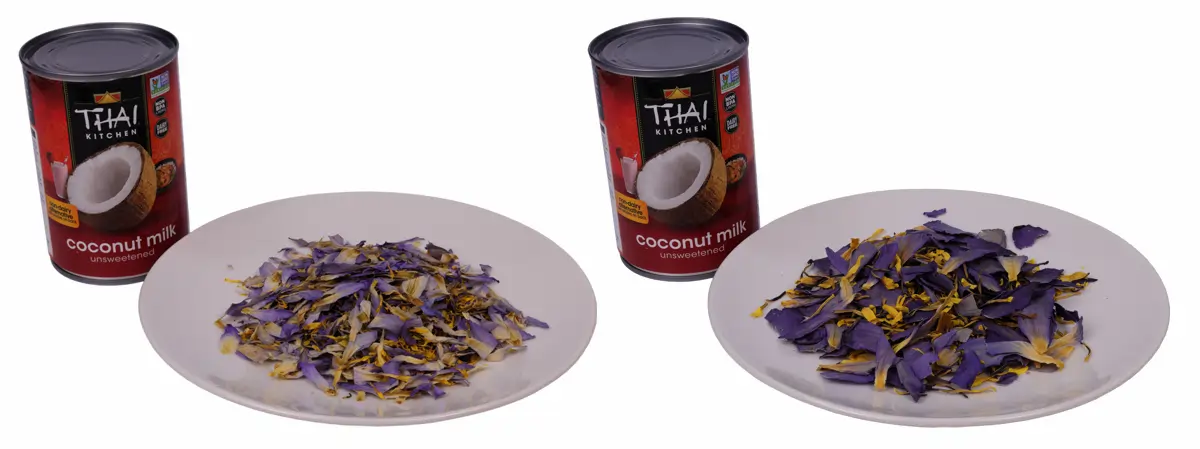
Our medium is canned whole coconut milk, which is vegan and alcohol-free. Coconut milk contains lauric acid, making it far superior to dairy milk, and it contains a higher concentration of saturated fats. When mixed with three parts water, it contains nearly double the saturated fat of a full cup of whole milk. Simmering coconut milk will easily dissolve the flower’s protective layer and extract its botanical properties.
Cooking Time and Temperature
Twenty minutes at a very low simmer hits the mark perfectly for blue lotus tea. It is just warm enough and long enough to dissolve the flower’s protective layer and extract the flavors and beneficial compounds without degrading them.
Blue Lotus Tea Recipe
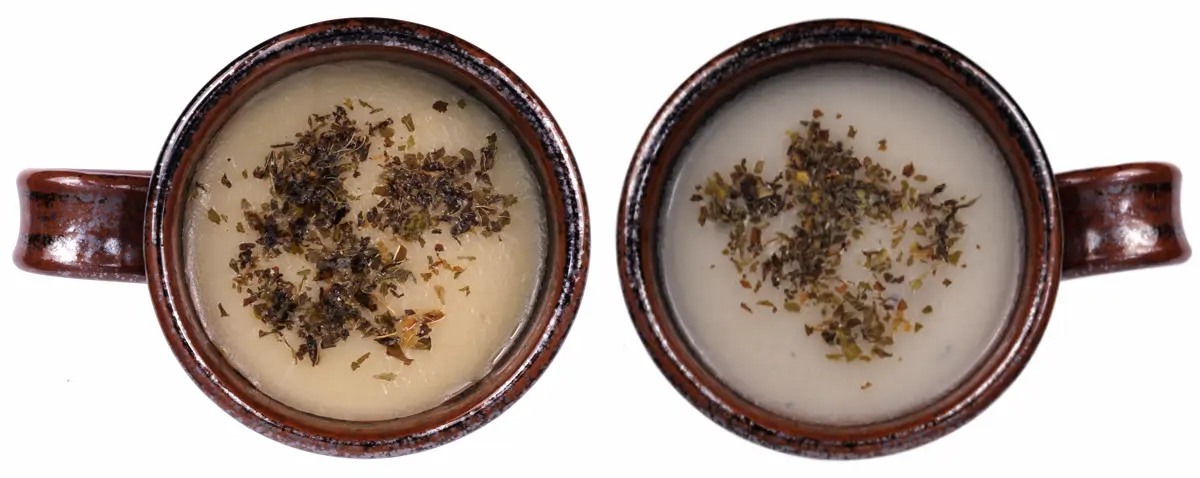
(Note: Because the flowers are being simmered, this is technically what is called an herbal concoction.)
What You’ll Need
- Small saucepan (with lid)
- Strainer or cheesecloth
- Measuring cup
- Spoon
Yield: 1 large mug
Prep Time: 2 minutes
Cook Time: 20 minutes
Calories: 180
Ingredients:
- 1/2 cup canned coconut milk (shake thoroughly before measuring)
- 1 1/2 cups water
- 3.5 grams dried blue lotus flowers
- A sprinkle of fresh spearmint leaf (optional)
Instructions:
- Pour coconut milk and water into the saucepan and mix until solid white.
- Bring to a low simmer.
- Add blue lotus flowers and lightly stir.
- Cover and simmer for 20 minutes, stirring occasionally.
- Remove from the heat, allow to cool, then strain using a strainer or cheesecloth. If using a strainer, you can compress the flowers with a spoon to squeeze out all the concoction (optional).
- Pour into your mug and add a sprinkle of fresh spearmint leaf on top.
Making the Tea
Using this recipe, I made a mug of tea with Nymphaea nouchali and Nymphaea nouchali var. caerulea flowers. Because the whole flower has woody parts that contain less essential oils and may slightly affect the flavor of the tea, I made my tea with the pure petals and stamens of both flowers.
Which strain of blue lotus flowers made the perfect cup of tea?
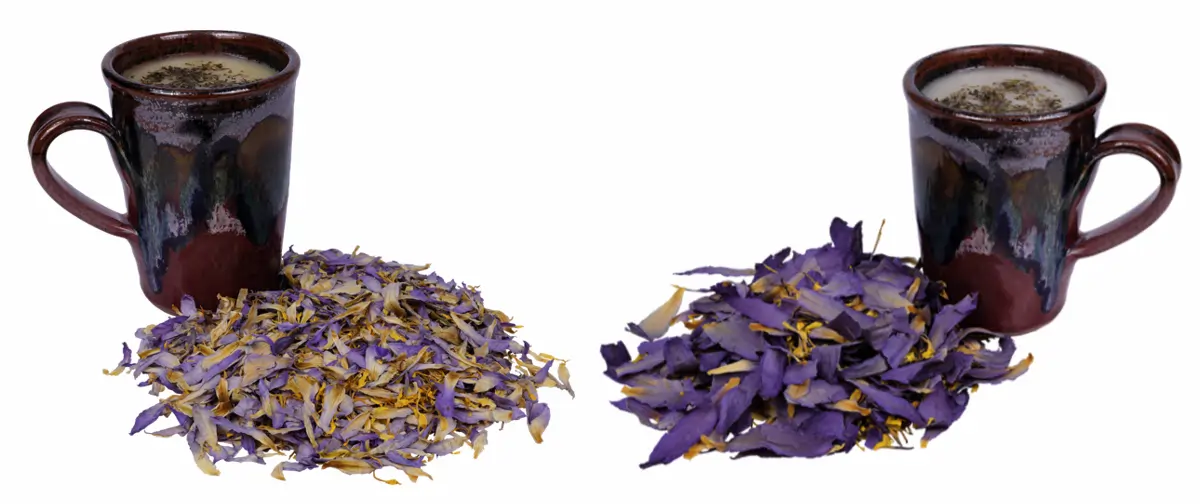
Both flowers made a fantastic tea using this recipe. The winner here turned out to be the recipe. You can take a look at the results from both and see which flower would make your perfect tea.
The Nymphaea nouchali-caerulea hybrid blue lotus flowers used in this comparison are grown in spring-fed ponds, and are cultivated for use in fragrances, tea, and natural supplements. The high quality Nymphaea nouchali var. caerulea flowers were sourced directly from the grower. Results from other sources may vary.
| Nymphaea nouchali var. caerulea | Nymphaea nouchali-caerulea Hybrid |
| Appearance Well-dried, good color, small petals. | Appearance Well-dried, good color, large petals densely covered in pollen. |
| Fragrance Fresh, earthy fragrance very similar to white lotus (Nymphaea ampla). | Fragrance Strong, sweet berry-candy-like fragrance. |
| Essential Oils Low to moderate amount of essential oil visible after brewing. | Essential Oils Significant amount of essential oil visible in coconut milk after brewing. |
| Flavor Mild earthy flavor. Non-bitter. | Flavor Very faint floral, noticeably bitter flavor. Did not feel the need to sweeten. |
| Experience Good flavored tea. The flowers paired well with the coconut milk. | Experience Enjoyable tea after getting accustomed to the bitterness. Calming. |
I had a lot of fun researching this recipe and making the tea. Did you enjoy the article? Have you tried the recipe, or do you have your own recipe for blue lotus tea? I would love to hear about it in the comments.